
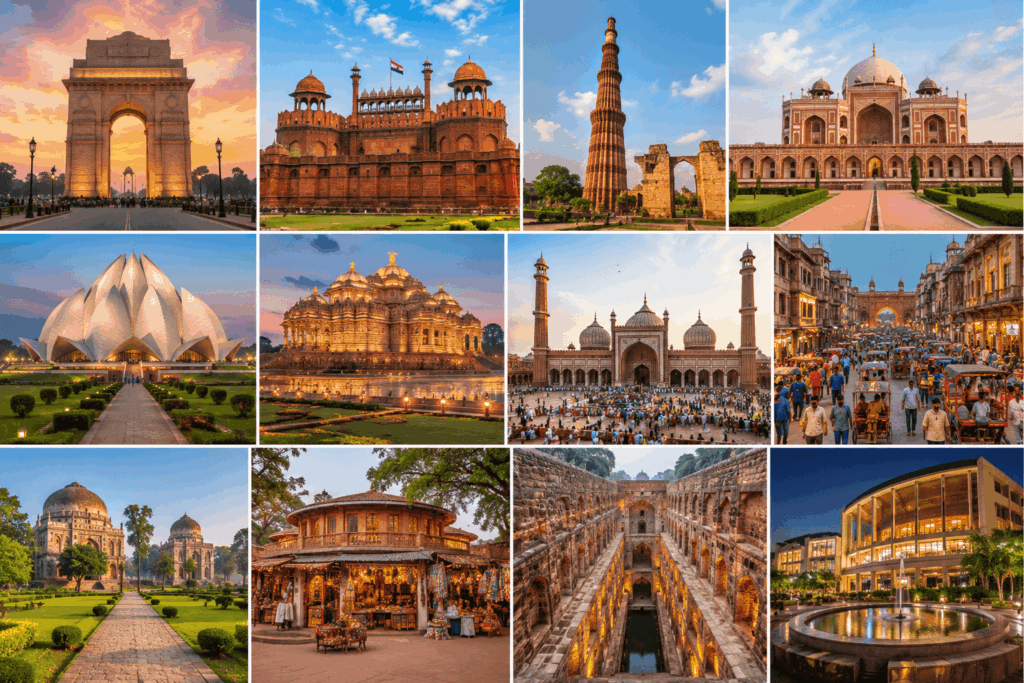
Best Places to Visit in Delhi: Explore the Heart of India
Delhi is one of those cities that can feel overwhelming at first, but once you start exploring, you quickly realise how much it has to offer.
It is a city where centuries-old monuments stand alongside modern buildings, where quiet gardens sit just a short drive from busy markets, and where street food can be just as memorable as a grand historical monument.
From the magnificent Red Fort and India Gate to the peaceful Lodhi Garden and colourful streets of Chandni Chowk, Delhi offers something for every kind of traveller.
Whether you are visiting Delhi for the first time or returning to discover something new, these are some of the best places to visit in Delhi.
1. India Gate – A Symbol of Delhi
India Gate is one of the most recognisable landmarks in Delhi.
Standing proudly in the heart of the city, this impressive war memorial is surrounded by wide roads and green lawns. It is particularly beautiful in the evening when the monument is illuminated and the surrounding area comes alive with visitors.
A visit to India Gate is especially enjoyable around sunset. Families come for an evening walk, children play on the lawns and the atmosphere becomes lively without feeling rushed.
If you are visiting Delhi for the first time, India Gate is an easy place to add to your itinerary.
Best for: Evening walks, photography, families and sightseeing.
2. Red Fort – Walk Through Delhi’s History
The Red Fort is one of Delhi’s most important historical landmarks.
Built by Mughal emperor Shah Jahan, the magnificent red sandstone fort reflects the architectural grandeur of the Mughal era. Its massive walls, elegant gateways and historic buildings tell stories of a Delhi that existed centuries ago.
Take your time while exploring the fort rather than simply taking a few photographs outside. The architecture and courtyards provide a fascinating glimpse into India’s royal past.
The Red Fort also holds enormous national importance and is closely associated with India’s Independence Day celebrations.
Best for: History lovers, architecture enthusiasts and photography.
3. Qutub Minar – A Masterpiece of Architecture
No trip to Delhi feels complete without seeing the Qutub Minar.
The towering monument rises dramatically above the surrounding Qutub complex and is one of the city’s most famous historical attractions. Its detailed stone carvings and Indo-Islamic architectural elements make it particularly impressive up close.
The surrounding complex contains several other historic structures, so give yourself enough time to explore beyond the minaret itself.
For photographers, the Qutub complex offers plenty of interesting angles, especially during the softer light of morning or late afternoon.
Best for: History, architecture and photography.
4. Humayun’s Tomb – A Peaceful Architectural Gem
Humayun’s Tomb is one of the most beautiful monuments in Delhi.
Surrounded by carefully planned gardens, the monument is known for its grand structure, symmetrical design and red sandstone and white marble details.
The tomb is also significant in the development of Mughal architecture in India and is often admired for the way its gardens, pathways and architecture come together.
Compared with some of Delhi’s busier attractions, the surrounding gardens can make the visit feel surprisingly peaceful.
Best for: Architecture, history, gardens and photography.
5. Lotus Temple – A Unique Place of Peace
The Lotus Temple is one of the most distinctive modern landmarks in Delhi.
Its beautiful white structure is designed in the shape of a lotus flower, making it instantly recognisable. The temple welcomes people of different faiths and is known for its quiet atmosphere.
Even if you are not particularly interested in architecture, the peaceful environment makes the Lotus Temple worth visiting.
Take some time to sit quietly and enjoy the surroundings rather than treating it as just another sightseeing stop.
Best for: Architecture, peaceful experiences and photography.
6. Akshardham Temple – A Grand Cultural Experience
Akshardham is one of the most impressive temple complexes in Delhi.
The detailed stonework, sculptures and enormous scale make the complex visually spectacular. Beyond the architecture, visitors can experience exhibitions and cultural presentations that explore Indian traditions and heritage.
The temple is best approached as a few-hour experience rather than a quick stop.
Remember that security rules apply, and photography restrictions are in place in parts of the complex.
Best for: Culture, architecture, spirituality and families.
7. Jama Masjid – Experience Old Delhi
Located in the heart of Old Delhi, Jama Masjid is one of the city’s most impressive historic mosques.
Its large courtyard, tall minarets and imposing architecture reflect the grandeur of Mughal-era Delhi.
But the experience becomes even more interesting when you explore the neighbourhood around it. Chandni Chowk, narrow lanes, traditional shops and famous food spots are all nearby.
A visit to Jama Masjid can easily be combined with an Old Delhi food and heritage walk.
Best for: History, architecture, culture and Old Delhi exploration.
8. Chandni Chowk – The Flavours of Old Delhi
Chandni Chowk is not a monument—it is an experience.
The busy lanes of Old Delhi are filled with shops, historic buildings, street food stalls and markets selling everything from fabrics and jewellery to spices and traditional sweets.
Food is one of the biggest reasons people visit. From crispy parathas and chaat to jalebi and traditional sweets, there is no shortage of things to try.
It can be crowded and chaotic, but that is exactly what makes Chandni Chowk feel so alive.
Best for: Street food, shopping, photography and experiencing Old Delhi.
9. Lodhi Garden – A Green Escape in the City
After exploring Delhi’s busy streets, Lodhi Garden offers a welcome change of pace.
The large green park contains several historic tombs and architectural remains surrounded by lawns, trees and walking paths.
Early morning is particularly pleasant, when the garden is filled with walkers, runners and people enjoying the peaceful surroundings.
It is a great place to slow down and enjoy a different side of Delhi.
Best for: Morning walks, photography, history and relaxation.
10. Dilli Haat – A Taste of India’s Craft Traditions
If you want to experience India’s regional crafts without travelling across the country, Dilli Haat is a great place to start.
The open-air market brings together handicrafts, textiles, artwork and food from different parts of India. It is a good place to browse for souvenirs while discovering regional flavours.
Unlike a typical shopping mall, Dilli Haat has a more traditional and colourful atmosphere.
Best for: Shopping, handicrafts, food and souvenirs.
11. National Museum – For History Lovers
Delhi is home to some of India’s most important museums, and the National Museum is one of the best places to explore the country’s long history.
Its collections cover thousands of years of Indian art, archaeology and cultural heritage.
If you are interested in understanding the history behind the monuments you see around Delhi, spending a few hours here can add much more context to your trip.
Best for: History, art, archaeology and culture.
12. Raj Ghat – A Place of Reflection
Raj Ghat is a peaceful memorial dedicated to Mahatma Gandhi.
Located beside the Yamuna River, the memorial is surrounded by gardens and offers a quiet environment away from the city’s busy roads.
The simplicity of the memorial is part of what makes the visit meaningful.
Best for: History, reflection and peaceful sightseeing.
13. Purana Qila – Delhi’s Ancient Past
Purana Qila, or the Old Fort, is another fascinating historical site in Delhi.
Its massive walls and grand gateways create an impressive introduction to the fort. The site is associated with different chapters of Delhi’s long and complex history.
The fort is especially interesting for travellers who enjoy exploring lesser-discussed historical places rather than only visiting the city’s most famous monuments.
Best for: History, architecture and photography.
14. Connaught Place – Delhi’s Modern Heart
Connaught Place, commonly known as CP, is one of the busiest commercial and social areas in central Delhi.
Its distinctive circular architecture houses restaurants, cafés, shops and businesses. The central park and surrounding streets are particularly lively in the evening.
It is a good place to end a day of sightseeing, enjoy dinner or simply watch Delhi’s urban life unfold.
Best for: Shopping, cafés, restaurants and nightlife.
Hidden and Less Crowded Places to Explore in Delhi
Delhi has plenty of attractions beyond the famous landmarks.
If you have extra time, consider exploring places such as:
- Sunder Nursery – beautiful landscaped gardens and historic monuments.
- Agrasen Ki Baoli – a fascinating historic stepwell in central Delhi.
- Mehrauli Archaeological Park – scattered historic monuments surrounded by greenery.
- National Rail Museum – an interesting stop for families and railway enthusiasts.
- Garden of Five Senses – a peaceful place for an evening walk.
- Hauz Khas Village – a mix of historic ruins, cafés, boutiques and urban culture.
These places can help you experience a quieter and more contemporary side of the capital.
Best Time to Visit Delhi
The best time to explore Delhi is generally during the cooler months.
October to March is usually the most comfortable period for sightseeing, especially if you plan to spend a lot of time outdoors.
April to June can become extremely hot, with afternoon temperatures making outdoor sightseeing uncomfortable.
July to September brings the monsoon season. The rain can provide some relief from the heat, but outdoor plans may need flexibility.
For a comfortable sightseeing experience, winter and early spring are usually the most pleasant choices.
How Many Days Are Enough for Delhi?
If it is your first visit, 3 to 4 days can give you a good introduction to Delhi.
Day 1 – Old Delhi
Explore:
- Red Fort
- Jama Masjid
- Chandni Chowk
- Old Delhi food streets
- Raj Ghat
Day 2 – Central Delhi
Visit:
- India Gate
- Rashtrapati Bhavan area
- National Museum
- Connaught Place
Day 3 – South Delhi
Explore:
- Qutub Minar
- Humayun’s Tomb
- Lotus Temple
- Lodhi Garden
Day 4 – Culture & Shopping
Keep the final day flexible for:
- Akshardham
- Dilli Haat
- Sunder Nursery
- Hauz Khas
- Shopping and local food
Tips for Exploring Delhi
Delhi is a huge city, so a little planning can save you a lot of time.
- Start outdoor sightseeing early, especially during warmer months.
- Group nearby attractions together instead of crossing the city repeatedly.
- Use the Delhi Metro for many major sightseeing routes.
- Keep some time for local food and markets rather than visiting monuments all day.
- Wear comfortable footwear because several historical sites involve plenty of walking.
- Keep your belongings secure in crowded markets and public areas.
- Carry water during sightseeing.
- Respect the rules at religious and heritage sites.
- Avoid trying to cover too many attractions in one day.
Final Thoughts
Delhi is not a city that can be understood in a single afternoon.
Its real charm comes from the contrast. You can stand beside a centuries-old Mughal monument in the morning, eat street food in the lanes of Old Delhi at lunchtime, relax in a peaceful garden in the afternoon and finish the day under the lights of India Gate or Connaught Place.
The best places to visit in Delhi are therefore not limited to a list of monuments. They are experiences that together tell the story of India’s capital.
So take your time, explore beyond the obvious attractions, try the local food and leave some room for unexpected discoveries. Delhi can be noisy, crowded and chaotic—but that energy is also what makes the city unforgettable.